
Last Updated on 7 July 2026
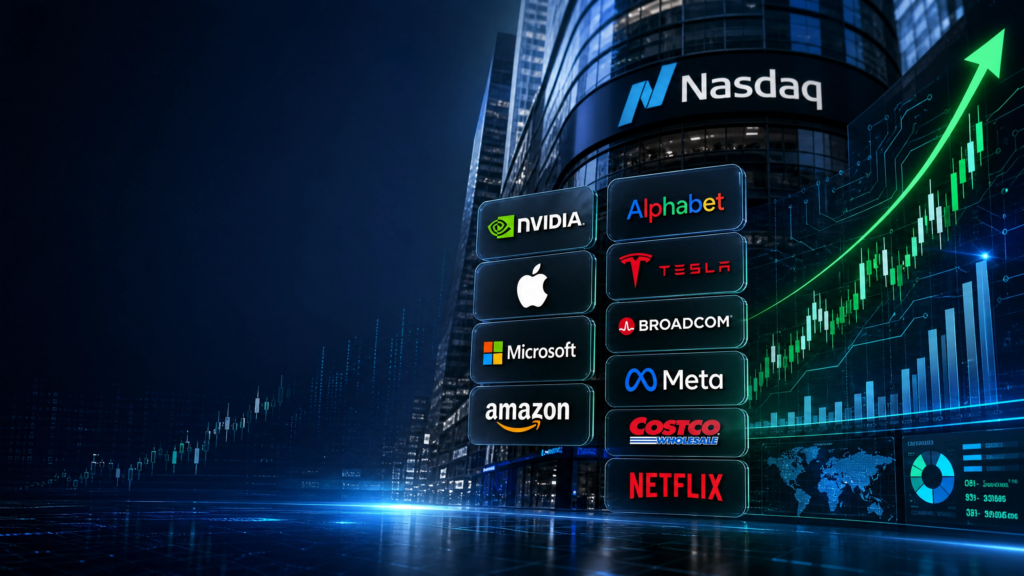
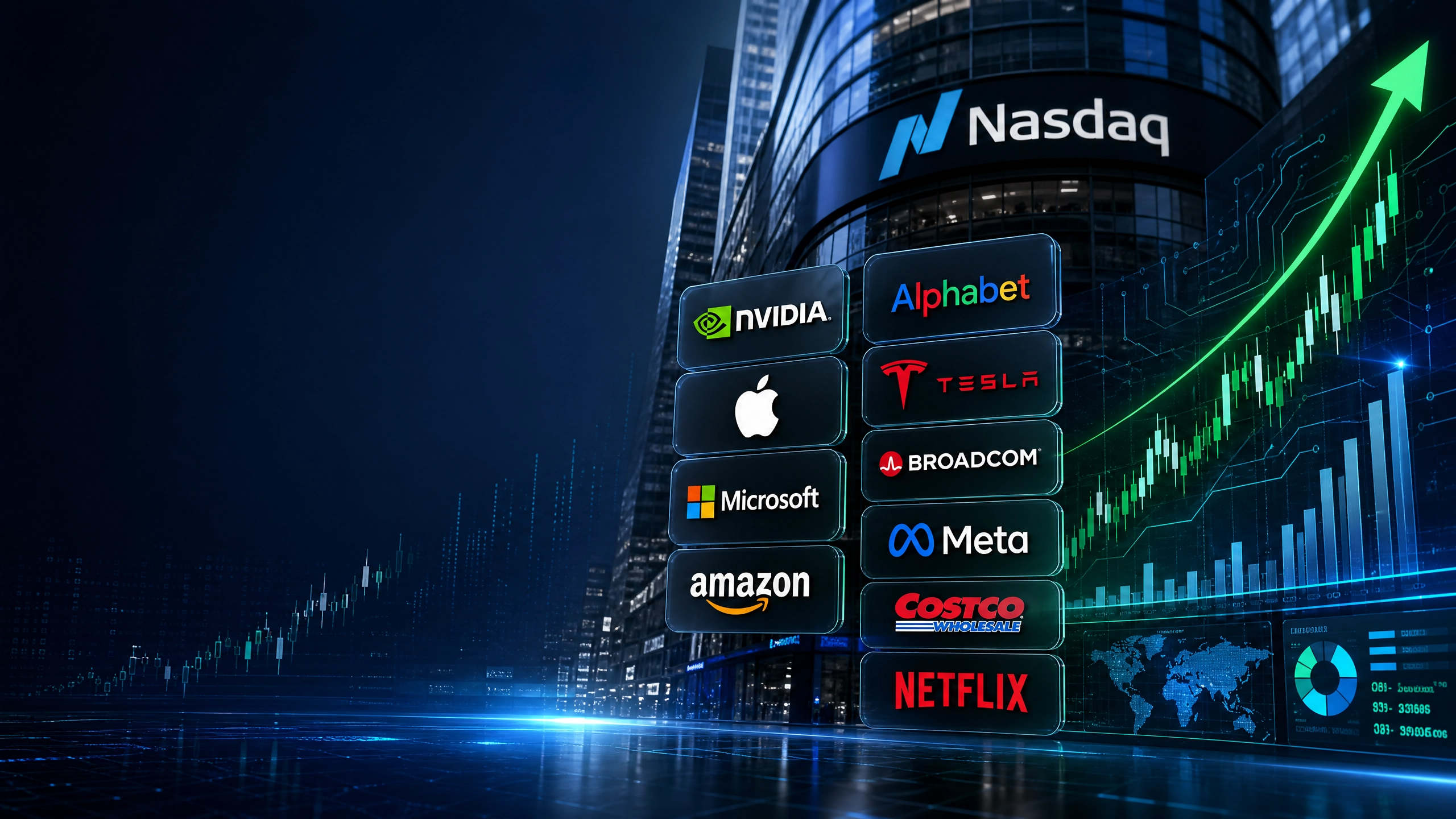
Top 10 Companies on Nasdaq by Market Cap – Complete 2026 Guide is designed to help investors understand the largest companies listed on the Nasdaq exchange. These companies lead industries such as artificial intelligence (AI), cloud computing, semiconductors, e-commerce, and consumer technology, making them some of the most valuable businesses in the world.
In this guide, you’ll learn what market capitalisation means, explore the top 10 Nasdaq companies in 2026, understand why they matter to investors, and discover the key factors to consider before investing in these stocks.
One of the simplest ways to understand a company’s size is through its market capitalisation, often called market cap. While market cap doesn’t determine whether a stock is a good investment, it provides valuable insight into a company’s scale, market influence, and position within the broader economy. It also plays a significant role in index construction, ETF weightings, and portfolio allocation.
As of 2026, the largest companies listed on the Nasdaq are at the forefront of technological innovation. Businesses such as Nvidia, Microsoft, Apple, Amazon, and Alphabet continue to benefit from long-term trends including AI adoption, enterprise cloud computing, digital transformation, and global consumer demand. Their combined market value represents a substantial share of the Nasdaq-100 Index, meaning their performance can have a noticeable impact on the overall market.
In this guide, you’ll discover:
- The top 10 Nasdaq companies by market capitalisation in 2026
- How market capitalisation is calculated and why it matters
- What makes these companies market leaders
- The sectors driving their long-term growth
- Key factors investors should evaluate before investing
- Opportunities and risks for Indian investors considering Nasdaq stocks
Whether you’re just beginning to explore US equities or looking to better understand the world’s largest publicly traded companies, this guide will help you evaluate the biggest names on the Nasdaq with greater confidence. The Top 10 Companies on Nasdaq by Market Cap continue to attract investors because they represent some of the world’s largest and most influential publicly traded companies.
What Does Market Capitalisation Mean?
Understanding the Top 10 Companies on Nasdaq by Market Cap helps investors compare industry leaders and identify businesses with strong long-term growth potential. Market capitalisation, commonly known as market cap, is the total market value of a company’s outstanding shares. It is one of the most widely used metrics for measuring a company’s size and is often the first factor investors consider when comparing publicly listed businesses.
The formula is straightforward:
Market Capitalisation = Current Share Price × Total Outstanding Shares
For example, if a company has 1 billion outstanding shares and each share trades at $100, its market capitalisation would be $100 billion.
Unlike revenue or profit, market cap reflects how the stock market currently values a company. Since share prices fluctuate throughout the trading day, a company’s market capitalisation also changes continuously.
Why Market Cap Matters
Market capitalisation provides more than just an estimate of company size. It helps investors understand how influential a business is within the market and how much weight it carries in major stock indices.
Generally, companies are classified into three categories:
| Market Cap Category | Approximate Value | Typical Characteristics |
|---|---|---|
| Large-Cap | Above $10 billion | Established businesses with stable operations and global presence |
| Mid-Cap | $2 billion–$10 billion | Growing companies with higher expansion potential |
| Small-Cap | Below $2 billion | Emerging businesses that may offer higher growth but greater risk |
Most companies featured in the Nasdaq’s top rankings fall into the large-cap category, with several now valued in the trillions of dollars.
Why Investors Track Market Cap
Market capitalisation influences far more than a company’s ranking on the stock exchange. It affects:
- Index weightings in the Nasdaq-100 and Nasdaq Composite
- Holdings of ETFs and mutual funds
- Institutional investment decisions
- Market sentiment during earnings seasons
- Portfolio diversification strategies
Because many index funds are market-cap weighted, the largest companies often receive the biggest allocations. This means that significant price movements in a few mega-cap stocks can influence the performance of the entire index.
It’s important to remember that a larger market cap does not automatically make a company a better investment. A company may be highly valued because investors expect strong future growth, while another with a smaller market cap could be fundamentally undervalued. Smart investors evaluate market cap alongside financial performance, valuation metrics, competitive advantages, and long-term growth prospects.
Top 10 Companies on Nasdaq by Market Cap – Complete 2026 Guide
The Top 10 Companies on Nasdaq by Market Cap are ranked based on their current market capitalisation, which changes as share prices fluctuate. These companies are among the largest Nasdaq-listed businesses and have a significant influence on the Nasdaq-100 Index and global financial markets.
| Rank | Company | Ticker | Industry | Why It Matters |
|---|---|---|---|---|
| 1 | Nvidia | NVDA | AI & Semiconductors | Global leader in AI GPUs powering data centres, cloud infrastructure, and machine learning. |
| 2 | Apple | AAPL | Consumer Technology | Generates consistent revenue through its ecosystem of hardware, software, and services. |
| 3 | Microsoft | MSFT | Cloud Computing & AI | Dominates enterprise software while expanding rapidly through Azure and AI solutions. |
| 4 | Amazon | AMZN | E-commerce & Cloud | Combines the world’s largest online marketplace with Amazon Web Services (AWS). |
| 5 | Alphabet | GOOGL / GOOG | Search, Advertising & AI | Owns Google, YouTube, Android, and continues investing heavily in artificial intelligence. |
| 6 | Tesla | TSLA | Electric Vehicles & Energy | A major player in electric mobility, battery technology, and autonomous driving innovation. |
| 7 | Broadcom | AVGO | Semiconductors | Supplies networking, AI infrastructure, and enterprise software solutions worldwide. |
| 8 | Meta Platforms | META | Social Media & AI | Operates Facebook, Instagram, WhatsApp, and is investing aggressively in AI technologies. |
| 9 | Costco Wholesale | COST | Retail | A membership-based retail giant known for resilient earnings and customer loyalty. |
| 10 | Netflix | NFLX | Streaming Entertainment | Continues to lead the global subscription streaming industry through original content and international expansion. |
Note: Market capitalisation changes every trading day as stock prices fluctuate. Rankings may vary depending on market conditions and the source of financial data. Always verify the latest figures before making investment decisions.
What Makes These Companies Market Leaders?
Although these companies operate in different industries, they share several characteristics that have helped them reach enormous market valuations.
Strong Competitive Advantages
Most of these businesses have built durable competitive moats through technology, intellectual property, global brands, or network effects. Their leadership positions make it difficult for competitors to gain market share.
Consistent Financial Performance
Many of the largest Nasdaq companies generate billions of dollars in annual revenue and free cash flow. Strong balance sheets allow them to invest in innovation while navigating economic uncertainty.
Exposure to Long-Term Growth Trends
Artificial intelligence, cloud computing, semiconductor demand, cybersecurity, digital advertising, e-commerce, and subscription-based services continue to drive long-term growth. Companies leading these industries often receive higher market valuations because investors expect future earnings to expand.
Global Operations
Unlike businesses focused on a single country, most Nasdaq mega-cap companies generate revenue across North America, Europe, Asia, and emerging markets. Their global presence helps diversify revenue streams and supports long-term growth.
Continuous Innovation
Whether it’s Nvidia developing next-generation AI chips, Microsoft integrating AI into enterprise software, Amazon expanding cloud services, or Meta investing in artificial intelligence, innovation remains one of the biggest reasons these companies continue to attract investor confidence.
Why the Largest Nasdaq Companies Matter to Investors
The Top 10 Companies on Nasdaq by Market Cap play a major role in the global stock market. Because of their massive valuations, they heavily influence the Nasdaq-100, many ETFs, and overall investor sentiment. Even small price movements in these companies can affect the broader market.
These companies are also among the biggest holdings in many ETFs and mutual funds, giving investors indirect exposure even if they don’t buy the stocks individually.
Beyond their size, these businesses lead industries such as artificial intelligence, cloud computing, semiconductors, digital advertising, and e-commerce. Their quarterly earnings often reflect broader technology and economic trends, making them closely watched by investors worldwide.
While these companies offer strong growth potential, investors should evaluate factors such as revenue growth, profitability, valuation, and competitive advantage instead of relying on market capitalisation alone. The Top 10 Companies on Nasdaq by Market Cap also play a crucial role in shaping the performance of market-cap-weighted indices and global investment portfolios.
Sector Breakdown of the Top 10 Nasdaq Companies
The Top 10 Companies on Nasdaq by Market Cap span multiple high-growth sectors, giving investors exposure to industries that are shaping the future of the global economy.
- Artificial Intelligence (AI): Nvidia, Microsoft, Alphabet, Meta, and Broadcom are driving AI innovation through chips, cloud platforms, and enterprise software.
- Semiconductors: Nvidia and Broadcom supply critical hardware powering AI, data centres, and modern computing.
- Cloud Computing: Microsoft Azure, Amazon Web Services (AWS), and Google Cloud continue to benefit from increasing enterprise cloud adoption.
- Consumer Technology: Apple leads with its integrated ecosystem of devices, software, and subscription services.
- Digital Advertising: Alphabet and Meta dominate online advertising through platforms such as Google, YouTube, Facebook, and Instagram.
- E-commerce: Amazon remains the global leader in online retail while expanding its cloud and advertising businesses.
- Electric Vehicles: Tesla continues to influence the EV market through innovation in electric mobility and energy solutions.
- Retail & Entertainment: Costco’s resilient retail model and Netflix’s leadership in streaming demonstrate that Nasdaq’s largest companies extend beyond traditional technology businesses.
Although technology dominates the Nasdaq, the index includes companies from multiple sectors. This provides investors with exposure to several long-term growth themes, but it also highlights the importance of maintaining a diversified investment portfolio.
How to Analyse the Top 10 Nasdaq Companies
While market capitalisation shows a company’s size, it shouldn’t be the only factor when evaluating a stock. Investors should consider several key fundamentals before making an investment decision.
Some of the most important factors include:
- Revenue and earnings growth – Is the company consistently growing its business?
- Profit margins – Higher margins often indicate operational efficiency.
- Valuation – Check metrics like the P/E ratio to see if the stock is fairly priced.
- Free cash flow – Strong cash flow supports future growth and innovation.
- Competitive advantage – Look for companies with strong brands, unique products, or market leadership.
- Future growth potential – Assess opportunities in AI, cloud computing, or other emerging sectors.
- Financial health – Review debt levels and balance sheet strength.
A large market cap reflects investor confidence, but long-term returns depend on the company’s ability to maintain growth and profitability.
Opportunities for Indian Investors
For Indian investors, the top Nasdaq companies offer exposure to some of the world’s most innovative businesses. Investors who want to improve their stock market knowledge can also explore educational resources and trading insights available on QuantsGrow. Investing in these stocks can help diversify a portfolio beyond the Indian market and provide access to global sectors such as AI, semiconductors, cloud computing, and digital technology.
Indian investors can invest in Nasdaq stocks through:
- International brokerage accounts
- Global mutual funds
- International ETFs
- Platforms offering US stock investing
Before investing, it’s important to consider factors such as currency fluctuations, taxation, investment costs, and your overall financial goals.
Risks of Investing in the Largest Nasdaq Companies
Although these companies are industry leaders, they are not risk-free. Their share prices can be affected by market volatility, economic slowdowns, rising interest rates, regulatory changes, and earnings disappointments.
Some common risks include:
- High stock valuations
- Technology sector concentration
- Currency risk for Indian investors
- Regulatory and geopolitical uncertainty
- Slower-than-expected earnings growth
Diversifying across different sectors and asset classes can help reduce overall investment risk. While the Top 10 Companies on Nasdaq by Market Cap have strong fundamentals, investors should still consider valuation, market volatility, and sector-specific risks before investing.
Although the Top 10 Companies on Nasdaq by Market Cap have delivered impressive growth over the years, investors should always diversify their portfolios and invest according to their financial goals and risk tolerance.
Conclusion
The top Nasdaq companies represent some of the world’s largest and most innovative businesses. Their leadership in AI, cloud computing, semiconductors, e-commerce, and digital services has helped them achieve massive market capitalisations and strong global influence.
However, market cap is only one measure of a company’s strength. Before investing, consider its financial performance, valuation, competitive position, and long-term growth prospects. A well-researched and diversified investment approach is the best way to build long-term wealth while managing risk. Understanding the Top 10 Companies on Nasdaq by Market Cap can help investors make informed decisions and build a diversified long-term investment portfolio.
Explore More Market Insights
If you’re interested in analysing stocks beyond market capitalisation, you can explore the QuantsGrow App. It offers AI-powered stock analysis, market analytics, screeners, news, and research tools to help investors make more informed decisions.
What are the top 10 companies on Nasdaq by market cap?
As of 2026, the largest Nasdaq-listed companies include Nvidia, Apple, Microsoft, Amazon, Alphabet, Tesla, Broadcom, Meta Platforms, Costco, and Netflix. These rankings can change as market prices fluctuate.
Which is the largest Nasdaq company in 2026?
Nvidia is currently the largest company listed on the Nasdaq by market capitalisation, driven by strong demand for its AI and data centre chips.
What does market capitalisation mean?
Market capitalisation (market cap) is the total value of a company’s outstanding shares. It is calculated by multiplying the current share price by the total number of outstanding shares.
Are the top Nasdaq stocks good for long-term investing?
Many top Nasdaq companies have strong market positions and long-term growth potential. However, investors should evaluate each company’s financial performance, valuation, and risks before investing.
Can Indian investors invest in Nasdaq stocks?
Yes. Indian investors can invest in Nasdaq-listed companies through international brokerage accounts, global mutual funds, or ETFs, subject to applicable regulations.
Is Nasdaq only for technology companies?
No. Although Nasdaq is known for technology stocks, it also includes companies from sectors such as retail, healthcare, consumer services, industrials, and entertainment
What is the difference between the Nasdaq Composite and the Nasdaq-100
The Nasdaq Composite includes almost all companies listed on the Nasdaq exchange, while the Nasdaq-100 tracks the 100 largest non-financial companies listed on the exchange.