
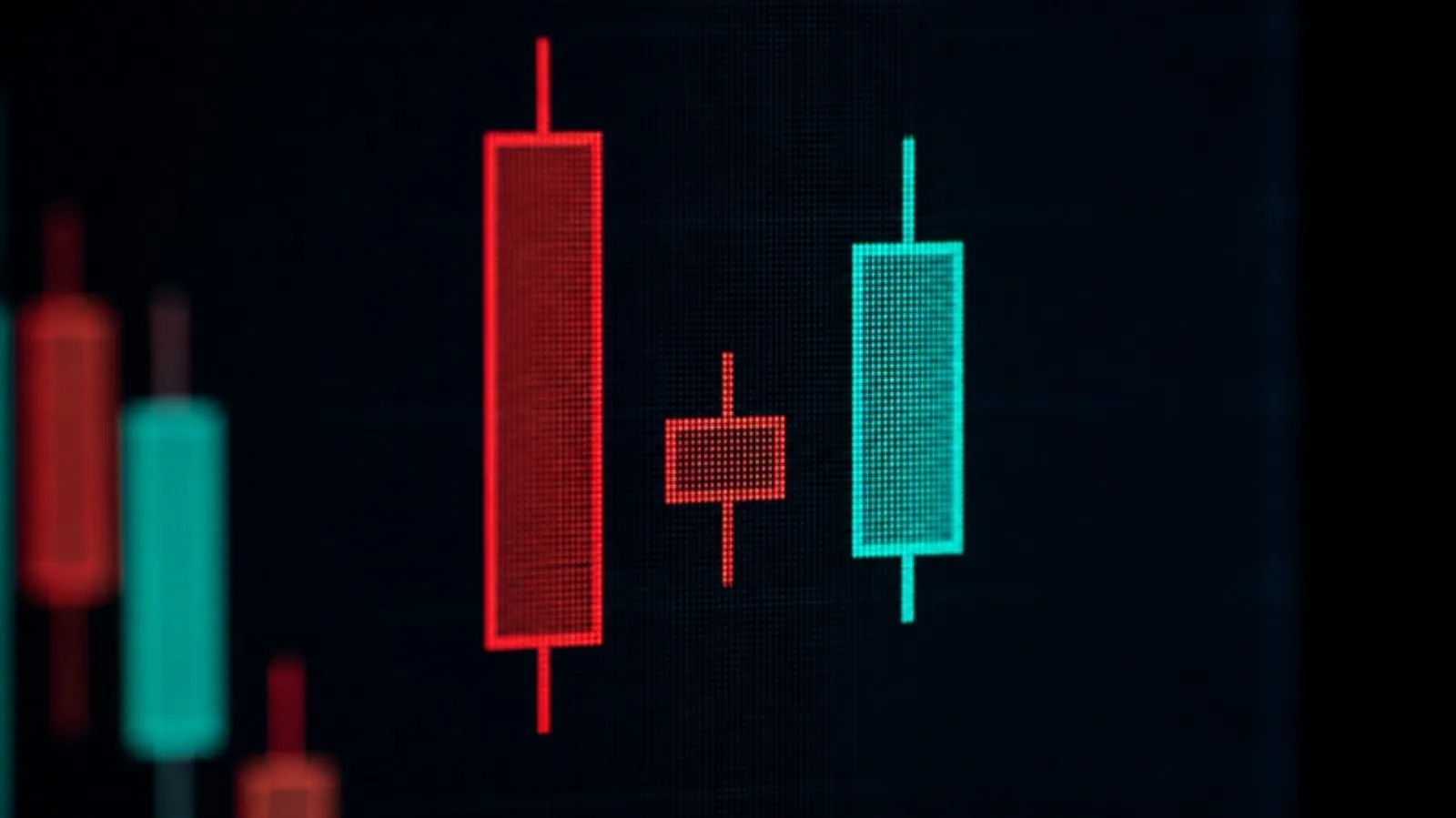
An inside bar is about the simplest pattern on a chart: a candle whose entire high-to-low range fits inside the previous candle’s range. It looks like nothing much, and that is exactly what it is. The market paused. Buyers did not push above the last high, sellers did not push below the last low, and the range compressed.
Compression tends to precede expansion, which is why traders care. This page covers how to read inside bars, why the weekly time frame is usually more useful than the daily, how NR7 and NR21 conditions add context, and where the pattern trips people up.
Reading the mother bar and the inside bar
The first candle, the mother bar, sets the range. The second, the inside bar, stays entirely within it. What the pattern means depends heavily on what came before.
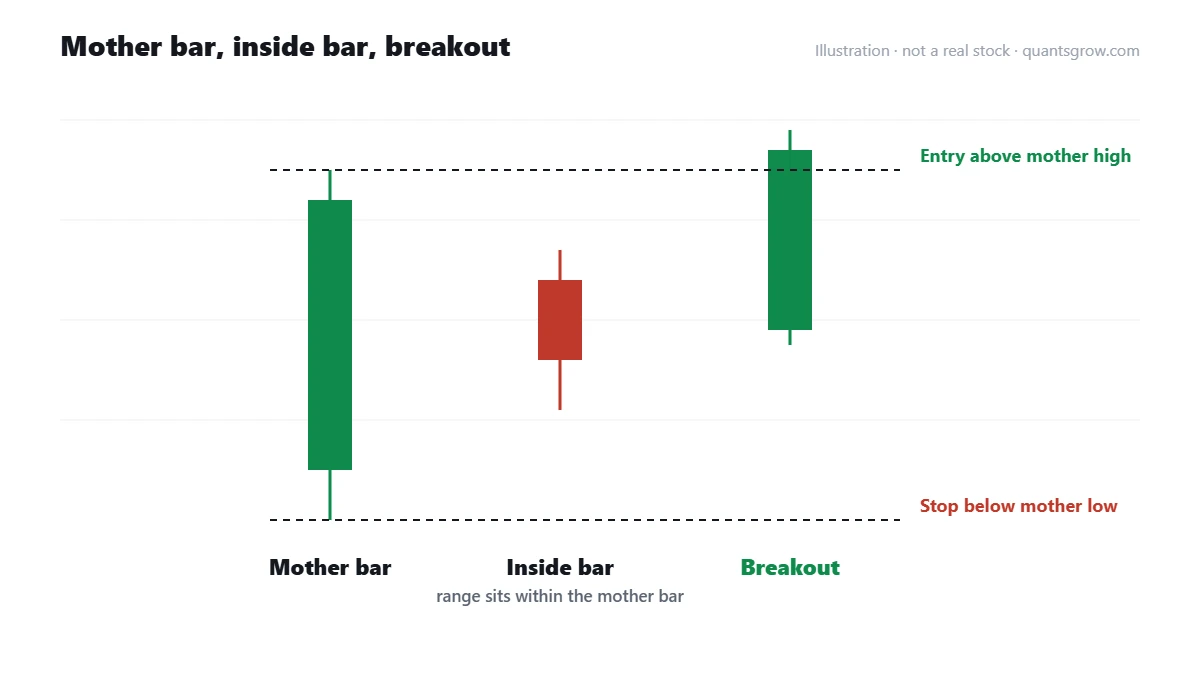
In a stock trending up, an inside bar after a strong week is usually a continuation pause. The stock is digesting its gains, and a break above the mother bar’s high suggests the trend is resuming. In a stock that has been falling, the same pattern can mark hesitation before a further drop. And in a stock going sideways for months, inside bars appear constantly and mean very little.
So the pattern is a timing tool, not a direction tool. Trend tells you which side to favour. The inside bar tells you where the line is.
Why the weekly time frame works better
On a daily chart, inside bars are everywhere, and many are just a quiet Tuesday. A weekly inside bar represents a full week in which the stock could not escape the previous week’s range, which carries more weight. It also filters out a lot of intraday noise and the random gaps that come from global cues overnight.
Weekly setups also suit people who cannot watch screens all day. You can identify the setup over the weekend, place an order above the mother bar’s high, and let the market decide.
NR7 and NR21: measuring how tight it is
An inside bar tells you the range is contained. NR7 and NR21 tell you how unusually narrow it is.
NR7 means the narrowest range of the last seven bars. When a week is both an inside bar and the narrowest in seven weeks, volatility has compressed meaningfully, and the eventual break is often sharper.
NR21 extends the lookback to 21 bars, so the compression is rarer and more extreme. These are less frequent signals, but they flag stocks that have gone unusually quiet relative to their own recent history.
Find inside bar stocks in the Nifty 500
The Quantsgrow Inside Bar screener runs daily across the full Nifty 500. It has three views: weekly inside bars with volume and price filters; NR7, the narrowest weekly range in seven weeks combined with an inside bar and a weekly CCI(34) reading between 80 and 100; and NR21, where the daily range is narrower than each of the last 21 weekly ranges inside a 21-week bar.
See inside bar stocks → Opens the live screener in the Quantsgrow app.Trading the break
The common approach is mechanical. Place a buy-stop just above the mother bar’s high, with a stop-loss just below the mother bar’s low (or, for a tighter stop, below the inside bar’s low). If the mother bar ran from ₹410 to ₹446 and the inside bar sits within it, the entry is around ₹447 and the stop around ₹409, about 8.5% risk. That might be too wide for some traders, which is why the tighter inside-bar-low stop is popular.
Many traders also cancel the order if it is not triggered within a set time, typically one or two bars. The pattern is about imminent expansion. If nothing happens for weeks, the setup has changed.
Where inside bars go wrong
False breaks are the main problem. The stock pokes above the mother bar’s high, triggers your entry, and then reverses straight back through the low. This is more common in range-bound markets and in stocks with no clear trend. Filtering for stocks in a solid uptrend, or for high relative strength, cuts down on these considerably.
The other trap is a huge mother bar. If the mother bar was a 20% range week, an inside bar within it is not much of a compression. It can still contain a lot of movement, and the stop will be very wide.
Frequently asked questions
What is an inside bar in trading?
An inside bar is a candlestick whose high is lower and whose low is higher than the previous candle, known as the mother bar. It shows a pause and a narrowing of the trading range.
Is an inside bar bullish or bearish?
Neither by itself. In an uptrend, a break above the mother bar’s high is usually treated as bullish continuation. In a downtrend, a break below the low is treated as bearish. The prior trend gives the context.
What is NR7 in stock trading?
NR7 stands for narrow range 7: a bar whose high-to-low range is the smallest of the last seven bars. It indicates volatility contraction, which often precedes a larger move.
Are weekly inside bars better than daily ones?
Many traders find weekly inside bars more reliable because they represent a full week of contained price action and filter out daily noise. Daily inside bars are far more frequent and produce more false signals.
Where should the stop-loss be for an inside bar trade?
Commonly just below the mother bar’s low for a long trade. Some traders use the inside bar’s low instead for a tighter stop, accepting a higher chance of being stopped out.
In short
An inside bar is the market holding its breath. In a strong stock, the exhale is usually up. Use the weekly chart, favour stocks already trending, pay attention when the range is unusually narrow, and keep the stop on the other side of the mother bar. Inside bars inside a broader VCP or breakout setup often give the most precise entries of all.
This page is for educational purposes only and is not investment advice or a recommendation to buy or sell any security. Investments in the stock market are subject to market risks. Examples are illustrative and do not refer to any specific stock unless clearly stated. Please do your own research and consider your risk tolerance before making any investment decision.